
Online vs On-Campus Degree: How to Choose
Deciding between an online and on-campus degree? This guide breaks down costs, flexibility, networking, and career impact to help you make the right call.

By Stacy Cignetti
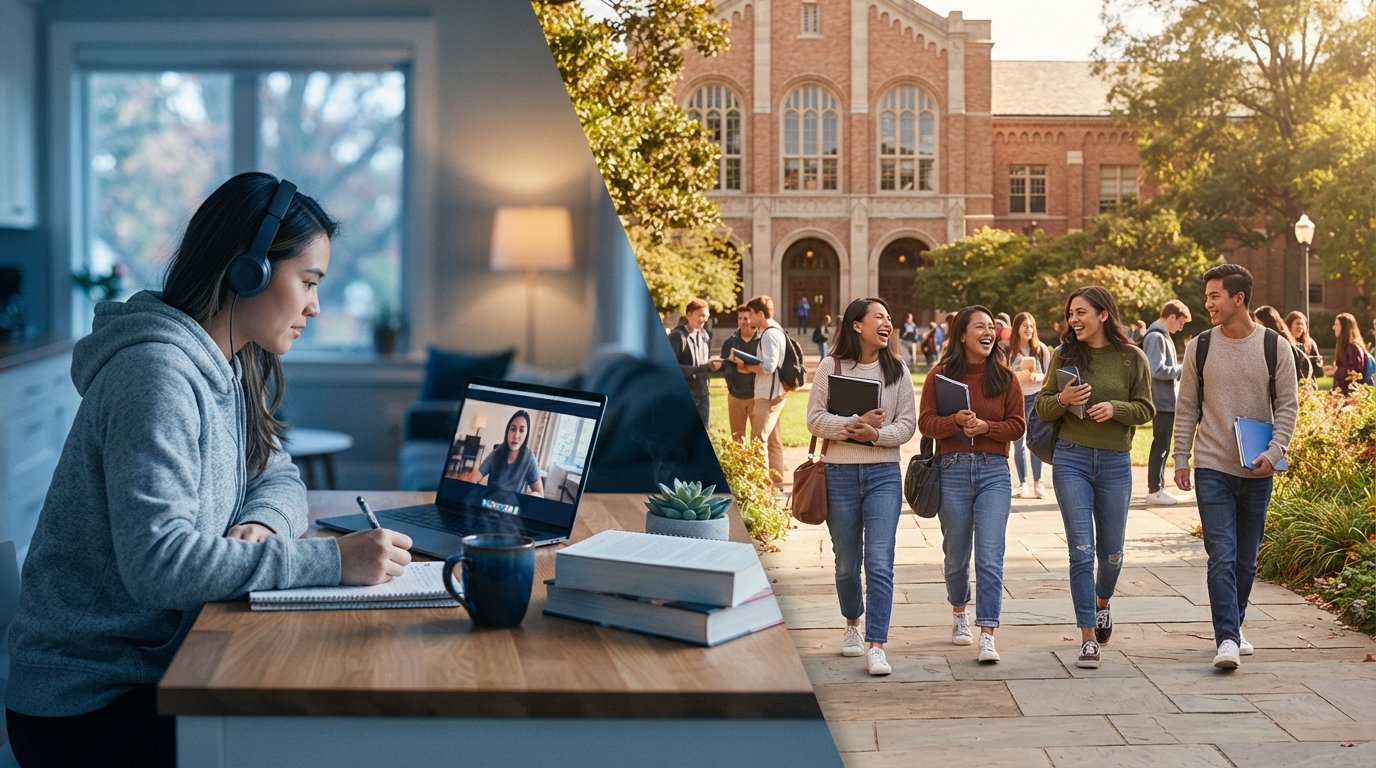
You are staring at two very different paths to the same destination: a college degree. One path has you packing bags and moving to a dorm. The other has you logging into a virtual classroom from your kitchen table. Both can lead to career success, but they are not interchangeable. The choice between an online and an on-campus degree is not about which one is objectively better. It is about which one fits your life, your learning style, and your career goals. This guide will walk you through the key factors that should drive your decision, from cost and flexibility to networking and campus life.
Assess Your Learning Style and Self-Discipline
Before you compare costs or curriculum, look inward. How do you learn best? On-campus programs thrive on structure. You have fixed class times, face-to-face interactions with professors, and a campus full of peers who can form study groups. If you need a physical classroom to stay focused, an on-campus degree may be your best bet. The routine of walking to class, sitting in a lecture hall, and raising your hand in person provides an external framework that some students cannot replicate at home.
Online programs, by contrast, demand a high level of self-motivation. You will watch lectures on your own schedule, participate in discussion boards asynchronously, and manage deadlines without a professor physically reminding you. This flexibility is a blessing for busy adults, but it can be a trap for students who procrastinate. Ask yourself: have I succeeded in self-paced projects before? Can I create my own schedule and stick to it? If you struggle with unstructured time, you might need to build extra systems, like weekly check-ins with an academic advisor or a dedicated study space, to thrive in an online format.
Your learning style also affects how you absorb material. Some people are auditory learners who benefit from live lectures. Others are visual learners who prefer reading transcripts and watching recorded videos. Online courses often rely on video, reading, and written assignments, while on-campus courses may include hands-on labs, whiteboard discussions, and group presentations. Think about your past academic successes. Were you happiest in seminars where you could debate ideas face to face? Or did you enjoy online modules where you could rewind a lecture as many times as needed? Your answer points to the right format.
Evaluate Your Career and Networking Needs
Your degree is not just an education. It is also a gateway to a professional network. On-campus programs offer built-in networking through career fairs, alumni events, student organizations, and casual conversations with peers. For fields like finance, consulting, or healthcare administration, these in-person connections can be invaluable. Recruiters often visit campuses to interview students, and internships are frequently brokered through personal relationships. If your target industry relies heavily on personal connections, an on-campus degree can give you a head start.
Online programs have evolved, but their networking is different. You will connect with classmates across the country or even the world, which can be great for a global perspective. Many online programs offer virtual career services, alumni directories, and online networking events. However, you will need to be proactive. You might have to reach out to professors via email, join LinkedIn groups, and attend virtual conferences to build your professional circle. If you are already working in your field, an online degree can help you expand your network without leaving your job. If you are a recent high school graduate with no professional contacts, the in-person networking of a campus may be more valuable.
Consider the specific career you want. For example, a nursing degree requires clinical hours, which are often easier to arrange through an on-campus program with local hospital partnerships. An online computer science degree, on the other hand, may not require physical presence, and tech companies are used to hiring remote workers. Research the typical hiring practices in your field. Do employers value the university name, the skills you learned, or the connections you made? If the university brand matters, an on-campus degree from a prestigious institution might be worth the higher cost. If skills matter more, an online program from a well-accredited school can be just as effective.
Compare the True Costs of Each Format
Tuition is the most obvious cost, but it is not the only one. On-campus degrees often include room and board, meal plans, transportation, and parking fees. These expenses can add thousands of dollars per year. Online degrees typically charge tuition and fees, but you can save on housing and commuting. However, do not assume online is always cheaper. Some online programs charge out-of-state tuition, while others offer a flat rate. Check the total cost of the program, including technology fees, online course materials, and proctoring fees for exams.
If you plan to work while studying, the cost of time matters too. On-campus schedules are rigid. You may have classes at 9 a.m. and 2 p.m., leaving you with awkward gaps that make part-time work difficult. Online programs let you study at night, on weekends, or during lunch breaks, which can be a huge financial advantage. A flexible online schedule might allow you to keep your full-time job, avoiding the loss of income that comes with quitting to attend classes.
Do not forget financial aid. Federal student aid, scholarships, and employer tuition reimbursement are available for both formats. Some employers even prefer online degrees because they show you can manage work and study simultaneously. Additionally, online programs often have lower overhead costs, which some schools pass on to students. But beware of for-profit online universities that charge high tuition with poor outcomes. Always check the accreditation and graduation rates of any program you consider. Our guide on choosing college degrees strategically can help you evaluate the value of different programs.
Examine Flexibility and Time Commitment
Life does not pause for a degree. If you are a working parent or a full-time employee, flexibility is often the deciding factor. Online programs allow you to study from anywhere, at any time, as long as you meet deadlines. This flexibility is ideal for those who cannot relocate or commit to a fixed class schedule. You can also accelerate your studies by taking more courses per term, or slow down if life gets busy. Many online programs offer multiple start dates throughout the year, so you do not have to wait for a fall semester.
On-campus programs provide a different kind of structure. The academic calendar is fixed, and you are expected to be present for classes, labs, and exams. This structure can be beneficial for students who need a clear plan and are not juggling many external responsibilities. If you are a recent high school graduate, the campus experience offers a natural transition from adolescence to adulthood. You have access to tutoring centers, library resources, and faculty office hours, all within walking distance.
Time commitment is not just about hours. It is about the intensity of the experience. On-campus students often spend 15 to 20 hours per week in class, plus additional time for homework and group projects. Online students might spend the same total hours, but they are spread across evenings and weekends. If you have significant family obligations, online learning can be a lifeline. But it also requires a dedicated study space and the discipline to say no to distractions. Ask yourself: how many hours per week can I realistically dedicate to coursework? Can I commit to a fixed schedule, or do I need the freedom to study when my kids are asleep?
Weigh the Campus Experience and Social Life
College is more than academics. It is a time of personal growth, social exploration, and lifelong friendships. An on-campus degree immerses you in a community of peers who are also navigating their early twenties. You can join clubs, attend sports events, and participate in traditions that create a sense of belonging. For many, this experience is priceless. It builds soft skills like teamwork, communication, and leadership in ways that are hard to replicate online.
Online students miss out on this communal experience, but they are not necessarily isolated. Many online programs host optional in-person meetups, virtual clubs, and group projects that foster connections. You can also build a network through internships or local professional organizations. However, the online experience requires more intentional effort to create social bonds. If you are outgoing and crave the energy of a campus, an on-campus degree may be more satisfying. If you are introverted or already have a strong social support system outside of school, online learning might feel more comfortable.
Think about the impact on your personal life. On-campus living means moving away from home, possibly to a different state. This can be exciting but also stressful. Online learning allows you to stay in your current job, keep your apartment, and maintain your routines. For adult learners, this stability is often essential. For traditional students, the leap to campus is part of the adventure. There is no right answer, but you must be honest about what you want from your college years.
Consider the Quality of the Program and Accreditation
Both online and on-campus programs can be excellent, but quality varies widely. Accreditation is the most important factor. A regionally accredited institution meets rigorous academic standards, and credits from such schools are more likely to transfer. Online programs from well-known public universities or established private colleges are often just as rigorous as their on-campus counterparts. However, be cautious of online programs from for-profit schools with low graduation rates and high student debt. Research the faculty, the curriculum, and the alumni outcomes.
Employers are generally accepting of online degrees, especially if the school is reputable. A 2025 survey by the Society for Human Resource Management found that 92% of employers viewed online degrees as equal to or better than traditional degrees. But the perception depends on the field. For highly regulated professions, like teaching or nursing, you must ensure the online program includes the required clinical or practicum hours. For business or tech roles, the skills matter more than the delivery method.
One way to compare quality is to look at the school's graduation and job placement rates. Also, check if the program offers access to the same career services as on-campus students. Some online programs have dedicated career coaches who help with resume writing and interview prep. Others may be less supportive. You can also read reviews from current and former students on sites like GradReports or Niche. And remember, a degree from a well-respected online program can be just as valuable as a traditional one, especially if you are already working in your field.
Decide Based on Your Long-Term Goals
Ultimately, the choice between online and on-campus should align with your long-term goals. If you are at the start of your career and want to build a strong professional network, an on-campus program might give you that foundation. If you are a mid-career professional looking to upskill for a promotion, an online degree allows you to apply new knowledge immediately at your current job. This immediate application can be a powerful learning tool, as you can test theories in the real world while still studying.
Consider your ideal timeline. Online programs often offer accelerated tracks, letting you earn a degree in 18 months instead of two years. On-campus programs follow a traditional 4-year or 2-year plan, though some allow summer courses to speed things up. If time-to-degree is your priority, online may be faster. But if you want a deep, immersive learning experience with research opportunities and faculty mentorship, the campus environment is hard to beat.
Also, think about your financial future. The debt you take on for a degree should be weighed against your expected salary. Online degrees can be more affordable, but they are not always. Use the U.S. Department of Education's College Scorecard to compare costs and earnings for different programs. And remember, you can always start with an online degree and transfer to an on-campus program later, or vice versa. Many schools offer flexible pathways that combine both formats.
Before you make a final decision, talk to current students or alumni from both types of programs. Ask about their experiences, challenges, and successes. You can also explore resources like DegreesOnline.Education to compare accredited online programs. This research will give you a realistic picture of what to expect.
In the end, the best choice is the one that you can commit to fully. Whether you sit in a lecture hall or a home office, your success depends on your engagement, effort, and willingness to learn. Both online and on-campus degrees can open doors. The key is to choose the path that fits your life today and your dreams for tomorrow.